Kling 4.0 can generate up to 30 seconds in one pass and read prompts up to 8,000 tokens. Here's how to structure a shot list it actually follows, plus ten templates to copy.
Released Oct 15, 20263–30 seconds8,000-token prompts
New model · Kling 4.0
What changed in Kling 4.0
Kuaishou's Kling AI fully launched Kling 4.0 on October 15, 2026. The headline change for prompt writers: a single generation can now run from 3 up to 30 seconds, long enough for a real long take with a beginning, middle and end, and the prompt box accepts up to 8,000 tokens, so you can describe every beat instead of hoping the model fills the gaps.
It also adds up to 10 keyframes and up to 15 reference assets (Omni Reference), stereo audio generated with the picture, and 720p, 1080p and 4K output. The catch: a 30-second clip has room to drift. Characters change outfits, the camera wanders, the story stalls. A timed shot list fixes that.
Write your prompt in six blocks. The timeline is the core; the rest keeps the long take consistent.
1. Header[Kling 4.0 · 30s · 16:9 · one take]
Tell the model the length, aspect ratio and that it is a single continuous take.
2. Subject & worldSubject: … / Scene: …
Who we follow (look, outfit, one defining detail) and where. Repeat the same wording later so the character stays consistent.
3. Style & lightStyle: … / Light: …
Film look, colour grade, time of day. One clear direction beats a pile of adjectives.
4. Timeline beats0–8s / 8–16s / 16–24s / 24–30s
Three to five timed beats. Each beat = what happens + how the camera moves. This is where 30 seconds and 8,000 tokens pay off.
5. SoundSound: …
Ambience, music mood, dialogue lines. Kling 4.0 generates stereo audio with the picture.
6. ConstraintsConstraints: …
No cuts, consistent face and outfit, no on-screen text, natural physics. Keeps long takes from drifting.
Tips that make long takes hold together
One camera idea per beat. “Slow push-in” or “arc to close-up”, not five moves at once.
Repeat the character description word for word if the subject reappears after leaving frame.
Give every beat a visible action. Static beats are where 30-second clips start to drift or loop.
End on a clear final frame (pull-back, freeze, light change) so the clip doesn't just stop.
Write it in the language you think in. Kling reads both English and Chinese well; don't mix both in one prompt.
Glossary
Camera-language glossary (EN / 中文)
The terms Kling 4.0 responds to most reliably. Use them inside your timeline beats.
English
中文
What it does
Extreme wide shot
大远景
Subject tiny in a huge environment; sets place and scale.
Wide / full shot
全景
Whole body visible with some surroundings.
Medium shot
中景
Waist up; good for gestures and dialogue.
Close-up
特写
Face fills the frame; for emotion.
Extreme close-up
大特写
A detail only: eyes, hands, an object.
Push-in / dolly in
推镜头
Camera moves toward the subject; builds tension or focus.
Pull-back / dolly out
拉镜头
Camera moves away; reveals context or ends a scene.
Tracking shot
跟拍 / 移动镜头
Camera travels alongside or behind a moving subject.
Pan
摇镜头(水平)
Camera rotates left or right from a fixed point.
Tilt
俯仰摇
Camera rotates up or down from a fixed point.
Arc / orbit shot
环绕镜头
Camera circles around the subject.
Crane up / down
升降镜头
Camera rises or lowers vertically, often to reveal.
Drone / aerial shot
航拍
High, flying viewpoint over the scene.
Handheld
手持
Slight natural shake; feels documentary and urgent.
Steadicam
斯坦尼康
Smooth floating movement while following on foot.
POV shot
主观镜头
We see through the character's eyes.
Over-the-shoulder
过肩镜头
Framed from behind one character's shoulder.
Low angle
仰拍
Camera below eye level; subject looks powerful.
High angle / top-down
俯拍 / 顶拍
Camera above; subject looks small or patterned.
Rack focus
焦点转移
Focus shifts from one plane to another mid-shot.
Shallow depth of field
浅景深
Subject sharp, background softly blurred.
Slow motion
慢动作
Action slowed for drama or detail.
Time-lapse
延时摄影
Time sped up: clouds, crowds, light changing.
Match / seamless transition
无缝转场
One scene flows into the next without a cut.
Guide
How to plan a 30-second Kling 4.0 long take
Think in beats, not in one sentence
A 30-second clip is long enough for a small story, and a single descriptive sentence leaves the model to invent everything in between. Split the time into three to five beats and give each one an action and a camera move. The templates on this page use four beats of roughly 8 seconds, which is a comfortable rhythm for most scenes.
Repeat the character description
Long takes are where characters drift: a red coat turns maroon, a hairstyle changes. Describe the main character once in detail at the top, then refer back to the same key details (for example 'the traveler in the red coat') inside each beat. Consistent wording is the cheapest way to keep a character consistent.
One camera idea per beat
Combining a drone shot, an orbit and a push-in in the same beat usually produces a messy, floating camera. Choose one clear move per beat from the glossary and let the next beat carry the next move. Static or slow moves also make lip-sync and faces more stable.
Use the sound line
Kling 4.0 generates audio with the picture, so a short sound line is worth writing: ambience ('rain on pavement, distant traffic'), music mood ('soft piano, slow tempo') and any spoken line in quotation marks. Keep dialogue short; one or two lines in 30 seconds is plenty.
Test short, then go long
Long generations cost more credits. Try your prompt at 5–10 seconds first to check the look and the character, then extend to 30 seconds once you like it. Save prompts that work in a notes app so you can reuse their structure for the next scene.
Templates
10 copy-ready 30-second templates
Each template is a complete Kling 4.0 prompt. Swap the subject and scene; keep the beat structure.
10 of 10 shown
#01 · Travel / mood film
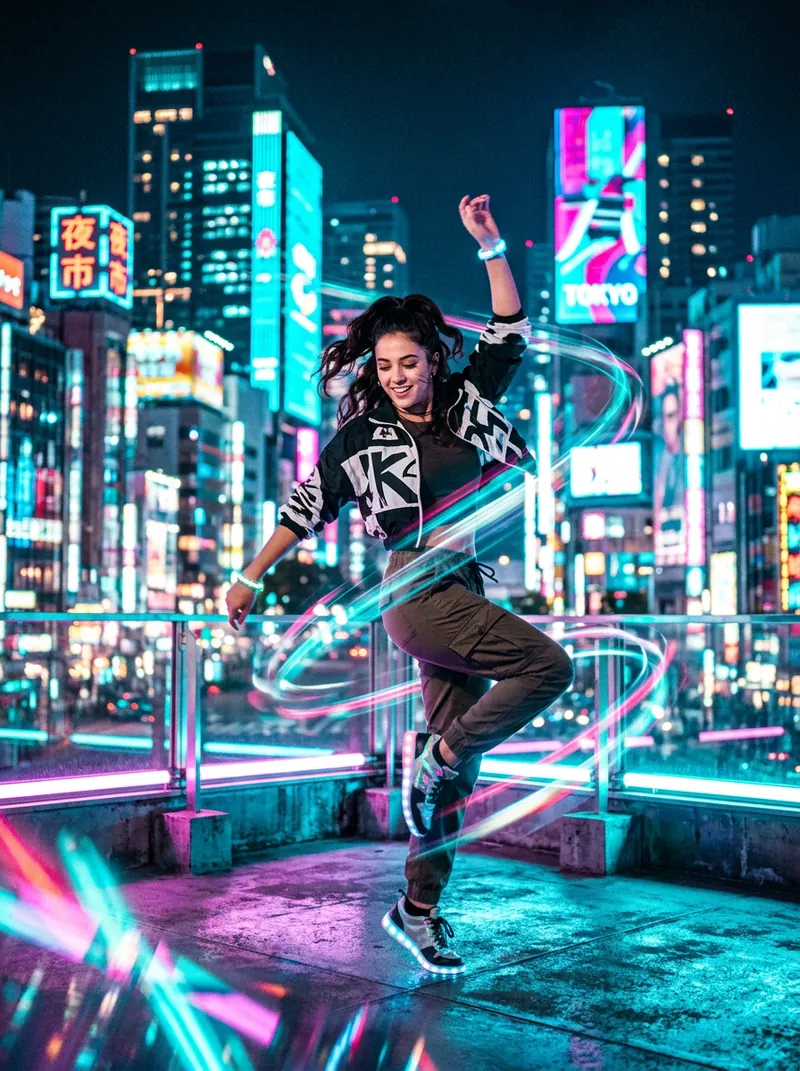
Neon city long take
[Kling 4.0 · 30 seconds · 16:9 · single continuous long take]
Subject: a lone traveler in a long red coat and black boots, short dark hair, carrying a small leather suitcase.
Scene: a rain-soaked neon street in an Asian megacity at dusk, glowing signs, puddles, crowds with umbrellas.
Style & light: cinematic, anamorphic look, teal-and-magenta colour grade, wet reflections, light haze.
Timeline:
- 0–8s: The traveler steps out of a subway exit into the rain and looks up at the towering signs. Camera: extreme wide shot, slow drone descent from rooftop height to street level.
- 8–16s: She walks through the crowd, umbrellas and reflections sliding past. Camera: steadicam tracking from behind, over-the-shoulder, foreground parallax.
- 16–24s: She stops at a small noodle stall, turns, and smiles as the cook waves. Camera: camera arcs around to a medium close-up of her face, shallow depth of field.
- 24–30s: She sits down as steam rises and the street lights flicker on. Camera: slow pull-back and crane up to a wide shot of the street.
Sound: rain on awnings, distant traffic, soft synthwave pad, the cook says 'Welcome back!'.
Constraints: one continuous 30-second take, no cuts, the same character face, hair and outfit from start to finish, natural physics and smooth motion, no on-screen text or watermark.
[Kling 4.0 · 30 seconds · 16:9 · single continuous long take]
Subject: a matte black wireless earbud case with a thin gold line, lid closed.
Scene: a dark studio with a glossy black floor and a single beam of light.
Style & light: premium commercial look, high contrast, crisp reflections, subtle particles in the air.
Timeline:
- 0–8s: The case sits in darkness; a beam of light slowly sweeps across the gold line. Camera: extreme close-up macro, very slow push-in.
- 8–16s: The lid opens by itself and the earbuds rise slightly on a soft glow. Camera: camera arcs 90° around the case, rack focus from lid to earbuds.
- 16–24s: The earbuds rotate in the air showing every angle, light rippling over them. Camera: slow orbit at eye level, shallow depth of field.
- 24–30s: The earbuds settle back, the lid closes with a soft click, light fades to a clean hero pose. Camera: pull back to a centered medium shot, static final frame.
Sound: deep cinematic whoosh, soft click when the lid opens and closes, minimal electronic pulse.
Constraints: one continuous 30-second take, no cuts, the same character face, hair and outfit from start to finish, natural physics and smooth motion, no on-screen text or watermark.
[Kling 4.0 · 30 seconds · 16:9 · single continuous long take]
Subject: a home cook's hands in a linen apron making hand-pulled noodles.
Scene: a sunlit rustic kitchen with a wooden table dusted with flour, a pot steaming on the stove.
Style & light: warm documentary food film, natural window light, rich textures, shallow depth of field.
Timeline:
- 0–8s: Flour falls into a bowl, water is poured, hands start kneading. Camera: top-down shot, slow push-in.
- 8–16s: The dough is stretched and slapped on the table, flour puffs into the light. Camera: low side angle, slow motion on the stretch.
- 16–24s: Noodles drop into boiling water, then into a bowl of red chili broth with scallions. Camera: tracking from pot to bowl, rack focus to the steam.
- 24–30s: Chopsticks lift the noodles toward the camera, steam curling. Camera: push-in to extreme close-up, end on the glistening noodles.
Sound: flour thuds, bubbling water, sizzling chili oil, quiet acoustic guitar.
Constraints: one continuous 30-second take, no cuts, the same character face, hair and outfit from start to finish, natural physics and smooth motion, no on-screen text or watermark.
[Kling 4.0 · 30 seconds · 16:9 · single continuous long take]
Subject: a young girl in a yellow raincoat holding a small glowing lantern, with a curious fox companion.
Scene: an ancient misty forest with giant mossy trees and floating light spores.
Style & light: Studio Ghibli-inspired painterly realism, soft volumetric god rays, lush greens and warm lantern glow.
Timeline:
- 0–8s: The girl pushes aside ferns and steps into a clearing; the fox follows. Camera: wide shot, slow push-in through the ferns.
- 8–16s: She walks along a fallen log bridge over a stream, the fox hopping beside her. Camera: side tracking shot, foreground leaves parallax.
- 16–24s: Spores swirl around the lantern and form a glowing path. Camera: camera arcs around her to a low angle, looking up at the swirl.
- 24–30s: The path leads to a giant glowing tree; she and the fox stand small before it. Camera: crane up and pull back to an extreme wide reveal.
Sound: birdsong, gentle stream, soft woodwind and harp theme, fox's small yip.
Constraints: one continuous 30-second take, no cuts, the same character face, hair and outfit from start to finish, natural physics and smooth motion, no on-screen text or watermark.
[Kling 4.0 · 30 seconds · 16:9 · single continuous long take]
Subject: a young woman in an oversized cream sweater, hair in a loose bun.
Scene: a small bright apartment with plants, a window overlooking the city at sunrise.
Style & light: soft natural light, airy pastel grade, authentic handheld vlog feel.
Timeline:
- 0–8s: She opens the curtains and morning light floods the room. Camera: handheld medium shot from behind, slight push-in.
- 8–16s: She makes pour-over coffee, steam rising in the sunbeam. Camera: follow to the counter, close-up on the pour, shallow depth of field.
- 16–24s: She waters plants and smiles at a small cat jumping onto the sill. Camera: slow pan following her along the window.
- 24–30s: She sits by the window with the coffee and opens a notebook. Camera: gentle pull-back to a wide shot of the cosy room.
Sound: soft lo-fi beat, kettle pouring, birds outside, a quiet 'good morning'.
Constraints: one continuous 30-second take, no cuts, the same character face, hair and outfit from start to finish, natural physics and smooth motion, no on-screen text or watermark.
[Kling 4.0 · 30 seconds · 16:9 · single continuous long take]
Subject: a vintage silver sports car driven by a man in a leather jacket and aviator sunglasses.
Scene: a winding coastal mountain road at sunset, cliffs and ocean below, a black SUV in pursuit.
Style & light: high-energy action film, warm orange sunset grade, motion blur, dust and lens flare.
Timeline:
- 0–8s: The sports car roars around a hairpin bend, tyres smoking. Camera: aerial drone shot, fast follow from above.
- 8–16s: The black SUV closes in; the driver glances at the mirror. Camera: camera swings from the road to an in-car close-up through the windshield.
- 16–24s: The car drifts through two tight bends, gravel spraying toward the lens. Camera: low tracking shot alongside the wheels, slow motion on the drift.
- 24–30s: The car bursts out of a tunnel into the sunset; the SUV skids to a stop behind. Camera: pull back and crane up to a wide shot over the ocean.
Sound: engine roar, screeching tyres, rising orchestral percussion, wind.
Constraints: one continuous 30-second take, no cuts, the same character face, hair and outfit from start to finish, natural physics and smooth motion, no on-screen text or watermark.
[Kling 4.0 · 30 seconds · 16:9 · single continuous long take]
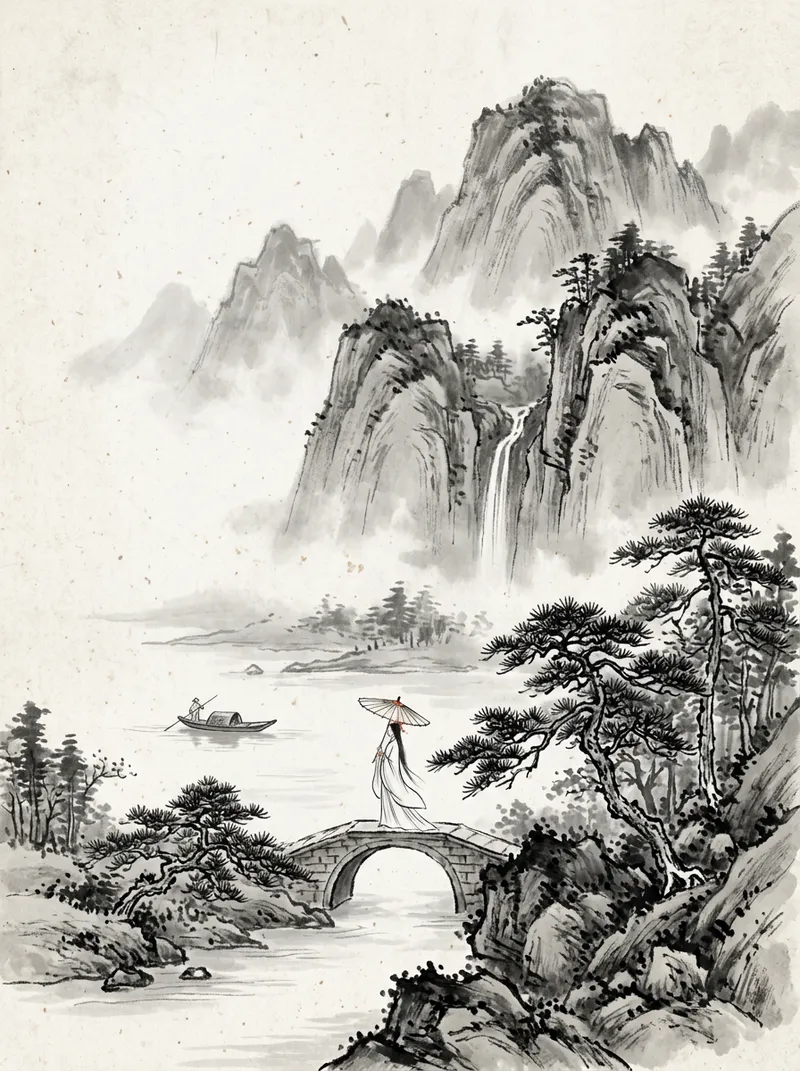
Subject: a swordswoman in white hanfu with a red sash, long black hair, holding a slender jian sword.
Scene: misty karst mountains above a sea of clouds, a lone pavilion on a cliff edge.
Style & light: Chinese ink-wash painting come to life, muted greys with vermilion accents, flowing fabric, soft diffused light.
Timeline:
- 0–8s: Clouds part to reveal the pavilion; she stands at the railing. Camera: extreme wide aerial shot gliding through clouds.
- 8–16s: She draws the sword and moves through a slow, graceful form, sleeves flowing. Camera: arc shot around her, medium shot, slow motion.
- 16–24s: Petals and ink strokes swirl with each sword movement. Camera: push-in to close-up on her focused eyes, rack focus to the blade.
- 24–30s: She sheathes the sword; ink spreads across the sky like a painting. Camera: crane up and pull back, the scene turns into a hanging scroll.
Sound: guqin melody, wind through pines, the ring of the blade.
Constraints: one continuous 30-second take, no cuts, the same character face, hair and outfit from start to finish, natural physics and smooth motion, no on-screen text or watermark.
[Kling 4.0 · 30 seconds · 16:9 · single continuous long take]
Subject: a bright modern three-bedroom apartment with oak floors and white walls.
Scene: from the front door through the living room to a balcony with a city view at golden hour.
Style & light: clean architectural film, natural light, true-to-life colours, smooth gimbal movement.
Timeline:
- 0–8s: The front door opens onto a hallway with a mirror and shoe cabinet. Camera: smooth forward dolly at eye level.
- 8–16s: The space opens into the living room with a sofa, rug and big windows. Camera: slow pan right revealing the whole room, wide-angle 18mm.
- 16–24s: Glide through the open kitchen, sunlight on the marble counter. Camera: tracking past the island, slight rack focus on a vase of flowers.
- 24–30s: The balcony doors slide open to the skyline at golden hour. Camera: push out onto the balcony and tilt up to the sky.
Sound: soft piano, gentle ambient room tone, distant city hum.
Constraints: one continuous 30-second take, no cuts, the same character face, hair and outfit from start to finish, natural physics and smooth motion, no on-screen text or watermark.
[Kling 4.0 · 30 seconds · 16:9 · single continuous long take]
Subject: a female basketball player in a white jersey number 7, braided hair.
Scene: an indoor arena at night, packed crowd, scoreboard tied with seconds left.
Style & light: broadcast sports film, high contrast arena lighting, sweat and detail, dramatic slow motion.
Timeline:
- 0–8s: She dribbles at the top of the key, eyes locked on the defender. Camera: low-angle medium shot, slow push-in.
- 8–16s: A crossover and a burst past the defender toward the basket. Camera: fast tracking shot alongside her, handheld energy.
- 16–24s: She rises for a fadeaway jumper, crowd frozen. Camera: arc around her in extreme slow motion, rack focus to the ball.
- 24–30s: Swish; the crowd erupts and teammates rush in. Camera: crane up and pull back to a wide shot of the celebrating arena.
Sound: sneaker squeaks, crowd roar fading to silence in slow motion, then explosion of cheers.
Constraints: one continuous 30-second take, no cuts, the same character face, hair and outfit from start to finish, natural physics and smooth motion, no on-screen text or watermark.
[Kling 4.0 · 30 seconds · 16:9 · single continuous long take]
Subject: a friendly presenter in a navy overshirt, mid-30s, speaking to camera.
Scene: a cosy studio with bookshelves, a desk lamp and a small whiteboard.
Style & light: clean YouTube-style lighting, soft key light, warm practicals in the background.
Timeline:
- 0–8s: The presenter waves and introduces the topic with a smile. Camera: static medium shot, eye level, slight push-in at the end.
- 8–16s: They walk to the whiteboard and draw a simple three-step diagram. Camera: smooth tracking shot following them to the board.
- 16–24s: They turn back to camera and explain the key point with hand gestures. Camera: medium close-up, shallow depth of field.
- 24–30s: They sit on the desk edge and invite viewers to try it. Camera: gentle pull-back to a wide shot of the studio.
Sound: the presenter says: 'Three steps, thirty seconds, let's go.' Light upbeat background music.
Constraints: one continuous 30-second take, no cuts, the same character face, hair and outfit from start to finish, natural physics and smooth motion, no on-screen text or watermark.
Kuaishou fully launched Kling 4.0 on October 15, 2026, after a September preview.
How long can a Kling 4.0 video be?
A single generation runs from 3 to 30 seconds. Kling also lets you extend an uploaded video further for multi-part stories.
How long can a Kling 4.0 prompt be?
Up to 8,000 tokens. You rarely need that much; a well-structured 30-second shot list is usually 150–400 words.
Do I need to write prompts in Chinese?
No. Kling understands English and Chinese. Pick one language per prompt; every template here comes in both.
Why does my 30-second video drift or change the character?
Long takes need anchors: a consistent character description, a visible action in every beat, one camera move per beat and a constraints line saying no cuts and the same outfit throughout. A reference image or keyframe helps too.